Asking about breakfast hours in English
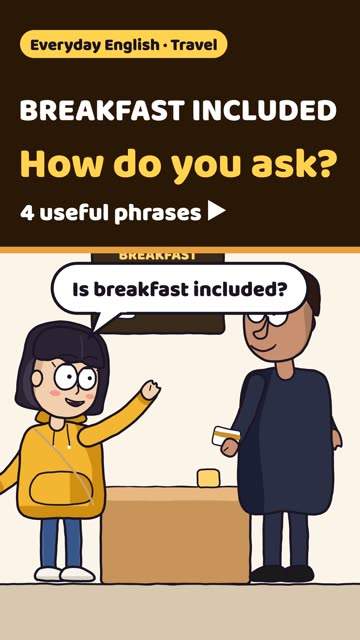
Everyday English for asking about breakfast hours. Key line: “Hi, what time is breakfast served in the morning?”
Full script
Asking about breakfast hours: how it really goes
You are staying somewhere and need to know when breakfast starts and ends. After this, you can ask the time naturally and check if your arrival is still okay.
Intermediate Everyday travel talk with exact times and small follow-up questions.
What people expect
In hotels and guesthouses, people usually ask about the breakfast hours directly. Staff will often give a simple time range, like from seven to ten, and that is enough.
Why the lines sound natural
“What time is breakfast?” is short and normal. “Can I come at nine-thirty?” works because English speakers often ask the exact time instead of giving a long explanation.
Common mistake
A learner may say “Breakfast what time start?” or translate word for word from Chinese. A better way is “What time is breakfast?” or “What time is breakfast served?”
The same moment at three levels
What Lin says first in each version. Pick the one that feels a little hard.
Quick check
1They say: “It's from six-thirty to ten, down in the dining room.” What do you say?
That's Lin's line in the scene.
2They say: “Maybe for pancakes, but there's still coffee and fruit.” What do you say?
That's Lin's line in the scene.
How to respond, line by line
When do you say “Hi, what time is breakfast served in the morning?”
Hi, what time is breakfast served in the morning?
Lin asks for the breakfast hours politely; natives often say it this short when checking a hotel schedule.
How do you respond to “It's from six-thirty to ten, down in the dining room”?
Lin answers: Great, because I only wake up for pancakes.
The answer gives the hours and the place in one quick sentence, like hotel staff often do.
How do you respond to “Then you're safe; the pancakes usually show up early”?
Lin answers: If I come at ten-oh-one, am I too late?
The speaker reassures Lin with a casual phrase; 'safe' here means the pancakes will still be there.
How do you respond to “Maybe for pancakes, but there's still coffee and fruit”?
Lin answers: Okay, I'll set two alarms and race downstairs.
The answer softens the bad news with 'maybe' and adds good options, which sounds helpful and friendly.
Useful phrases from this scene
What does “what time” mean?
what time.
Hi, what time is breakfast served in the morning?
What does “breakfast served” mean?
served breakfast.
Hi, what time is breakfast served in the morning?
What does “from six-thirty to ten” mean?
from 6:30 to 10:00.
It's from six-thirty to ten, down in the dining room.
What does “dining room” mean?
hotel restaurant.
It's from six-thirty to ten, down in the dining room.
What does “wake up for pancakes” mean?
get up just for pancakes.
Great, because I only wake up for pancakes.
What does “you're safe” mean?
you're fine.
Then you're safe; the pancakes usually show up early.
What does “show up early” mean?
appear early.
Then you're safe; the pancakes usually show up early.
What does “ten-oh-one” mean?
10:01.
If I come at ten-oh-one, am I too late?
What does “too late” mean?
too late.
If I come at ten-oh-one, am I too late?
What does “there's still coffee and fruit” mean?
coffee and fruit are still available.
Maybe for pancakes, but there's still coffee and fruit.
What does “set two alarms” mean?
set two alarms.
Okay, I'll set two alarms and race downstairs.
What does “race downstairs” mean?
run down quickly.
Okay, I'll set two alarms and race downstairs.
What does “breakfast waits” mean?
breakfast will wait.
Smart plan—breakfast waits, but pancakes don't believe in snooze.
What does “don't believe in snooze” mean?
won't use snooze.
Smart plan—breakfast waits, but pancakes don't believe in snooze.
Common mistakes here
Other ways they might say it
≈ It's from six-thirty to ten, down in the dining room.
≈ It's from six-thirty to ten, down in the dining room.
≈ Maybe for pancakes, but there's still coffee and fruit.
Key phrases
The lines worth keeping. Read them once before you go out.
Ask when breakfast is available
Natural for asking meal times
Give the time range
from...to... = a time range
Ask if ten-oh-one is too late
Polite way to check the cutoff
Say you need two alarms
Light way to say you may wake up late
Common phrases in this scene
Quick answers
What does “What time is breakfast served” mean, and when do you say it?
“What time is breakfast served?”: ask when breakfast is available. Natural for asking meal times.
What does “It's from six-thirty to ten” mean, and when do you say it?
“It's from six-thirty to ten.”: give the time range. from...to... = a time range.
What does “If I come at ten-oh-one, am I too late” mean, and when do you say it?
“If I come at ten-oh-one, am I too late?”: ask if ten-oh-one is too late. Polite way to check the cutoff.
What does “I'll set two alarms” mean, and when do you say it?
“I'll set two alarms.”: say you need two alarms. Light way to say you may wake up late.