Apologizing in English (advanced)
Advanced English for apologizing. Key line: “I was defensive, and that was unfair; you were right to call it out.”
Full script
Apologizing: how it really goes
These scenes show how to apologize after a mistake and try to fix the moment. You can learn how to sound sincere, accept the other person's reply, and offer help in a natural way.
Advanced This version focuses on more nuance, like admitting fault clearly, softening the tone, and keeping the moment calm.
Apology plus action
In English, a real apology often comes with a small fix, like buying a new coffee or helping clean up. That sounds more sincere than just saying sorry. It shows you know what happened and you want to help.
Soft words sound better
Lines like “I'm really sorry about that.” and “Can I help clean it?” work because they are calm and polite. People often use “can I,” “could I,” or “I’d like to” to make the apology feel less pushy.
Avoid word-for-word speech
A direct translation can sound stiff, like “I apologize to you” in every situation. More natural is “I'm sorry,” “I was rude,” or “Can we start over?” Say the problem clearly and keep the tone warm.
The same moment at three levels
What Lin says first in each version. Pick the one that feels a little hard.
Quick check
1They say: “Honestly, you showing up already makes it less dramatic than yesterday.” What do you say?
That's Lin's line in the scene.
2They say: “For the record, my haircut looked fine; your impression was just alarmingly accurate.” What do you say?
That's Lin's line in the scene.
How to respond, line by line
How do you respond to “Honestly, you showing up already makes it less dramatic than yesterday”?
Lin answers: I was defensive, and that was unfair; you were right to call it out.
How do you respond to “Thanks. I wasn't trying to win; I just didn't love being your punchline”?
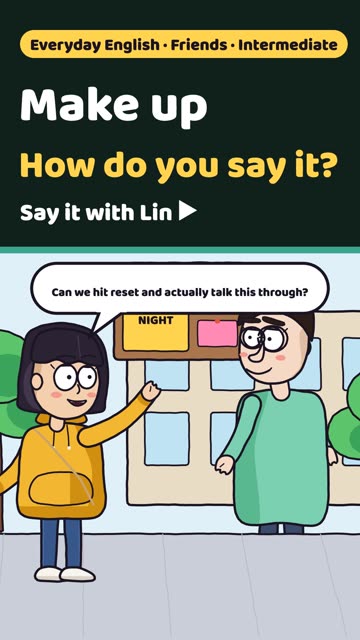
Lin answers: Yeah, I went for the joke instead of the truth, and it landed badly.
How do you respond to “For the record, my haircut looked fine; your impression was just alarmingly accurate”?
Lin answers: If you're up for it, I'd like to make it up—minus any haircut material.
Key phrases
The lines worth keeping. Read them once before you go out.
Soft way to start an apology
A gentle, natural opening
Say the problem clearly
Not attacking; just naming it
Fix it; make up for it
Often: make it up to you
Just to be clear
Good for a quick clarification
Common phrases in this scene
Quick answers
What does “Could I say I'm sorry” mean, and when do you say it?
“Could I say I'm sorry...?”: soft way to start an apology. A gentle, natural opening.
What does “call it out” mean, and when do you say it?
“call it out”: say the problem clearly. Not attacking; just naming it.
What does “make it up” mean, and when do you say it?
“make it up”: fix it; make up for it. Often: make it up to you.
What does “for the record” mean, and when do you say it?
“for the record”: just to be clear. Good for a quick clarification.