Tomar un tren de alta velocidad en inglés (avanzado)
Inglés avanzado para tomar un tren de alta velocidad. Frase clave: “And I still need my passport, right, not just the e-ticket?”
Guion completo
Tomar un tren de alta velocidad: cómo es de verdad
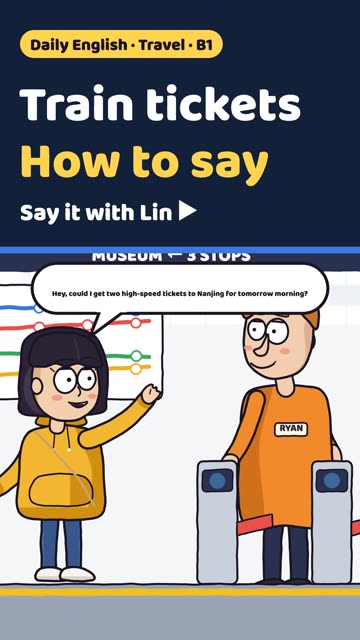
Esta escena trata de subir a un tren de alta velocidad en China, pedir ayuda, revisar la puerta y ocuparte de tu bolso. Después, puedes preguntar a dónde ir y qué necesitas antes de subir.
Avanzado Se centra en un viaje más detallado, los horarios y cómo manejar pequeños retrasos.
Primero revisa el tren y la puerta
En las estaciones de tren de alta velocidad de China, la gente suele revisar el número del tren, la puerta y el asiento antes de subir. El personal suele orientarte con carteles o números de puerta, así que preguntar por el número del tren suena normal y claro.
Por qué estas frases suenan naturales
“Can you help me find my train?” es suave y educada, así que suena mejor que un seco “Where is my train?” “Keep it with you” también es natural. Quiere decir que no dejes tu bolso solo y lo mantengas cerca.
La trampa: la regla de un solo documento
No des por hecho que todos los viajes requieren pasaporte. En China, para muchos viajes nacionales en tren de alta velocidad se usa un documento de identidad, mientras que algunos viajeros usan pasaporte, así que “Do I need my ID or passport?” es más seguro y natural.
El mismo momento en tres niveles
Lo que Lin dice primero en cada versión. Elige la que te parezca un poco difícil.
Chequeo rápido
1Dicen: “Sure—watch the gate on your ticket; they'll open it about fifteen minutes early.” ¿Qué dices tú?
Esa es la frase de Lin en la escena.
2Dicen: “Honestly, that's better than cutting it close with high-speed trains.” ¿Qué dices tú?
Esa es la frase de Lin en la escena.
Cada frase de la escena, en inglés
¿Cómo se dice «Hola, ¿podrías decirme cuándo debo ponerme en fila para mi tren» en inglés?
Puedes decir: Hi, could you tell me when I should line up for my train?
¿Qué significa «Sure—watch the gate on your ticket; they'll open it about fifteen minutes early» y cómo responder?
Significa «Claro: fíjate en la puerta de tu boleto; la abrirán unos quince minutos antes». Puedes responder: Got it. And I still need my passport, right, not just the e-ticket?
¿Cómo se dice «Entendido. Y todavía necesito mi pasaporte, ¿verdad? No solo el e-ticket» en inglés?
Puedes decir: Got it. And I still need my passport, right, not just the e-ticket?
¿Qué significa «Right. They’ll check your passport at security and again at the gate» y cómo responder?
Significa «Así es. Te revisarán el pasaporte en seguridad y otra vez en la puerta». Puedes responder: Thanks. I got here ridiculously early, so now I'm pacing for no reason.
¿Cómo se dice «Gracias. Llegué ridículamente temprano, así que ahora estoy dando vueltas sin motivo» en inglés?
Puedes decir: Thanks. I got here ridiculously early, so now I'm pacing for no reason.
¿Qué significa «Honestly, that's better than cutting it close with high-speed trains» y cómo responder?
Significa «La verdad, eso es mejor que llegar justo a tiempo con los trenes de alta velocidad». Puedes responder: Fair enough. I'll camp here and protect my emergency snacks with honor.
¿Cómo se dice «Tiene sentido. Me quedaré aquí y protegeré mis snacks de emergencia con honor» en inglés?
Puedes decir: Fair enough. I'll camp here and protect my emergency snacks with honor.
¿Qué significa «Perfect—if boarding gets delayed, your snack bag may become the station's celebrity» y cómo responder?
Significa «Perfecto: si se retrasa el embarque, tu bolsa de snacks puede convertirse en la celebridad de la estación». Puedes responder:
Frases clave
Las líneas que vale la pena guardar. Léelas una vez antes de salir.
hacer fila para este tren
Más específico que wait
la puerta que aparece en tu boleto
Aquí, gate significa la puerta de embarque
llegar en el último momento
a menudo significa casi tarde
sentirse nervioso sin necesidad
Muy común al hablar
Frases comunes en esta escena
Respuestas rápidas
¿Qué significa “line up for my train” y cuándo se dice?
“line up for my train”: hacer fila para este tren. Más específico que wait.
¿Qué significa “watch the gate on your ticket” y cuándo se dice?
“watch the gate on your ticket”: la puerta que aparece en tu boleto. Aquí, gate significa la puerta de embarque.
¿Qué significa “cutting it close” y cuándo se dice?
“cutting it close”: llegar en el último momento. a menudo significa casi tarde.
¿Qué significa “for no reason” y cuándo se dice?
“for no reason”: sentirse nervioso sin necesidad. Muy común al hablar.