Asking for directions in English (advanced)
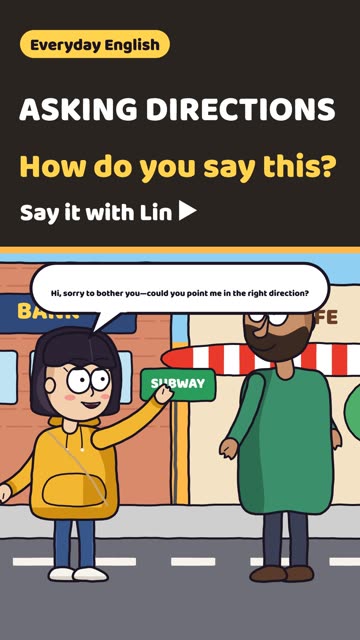
Advanced English for asking for directions. Key line: “Excuse me, could you point me toward the city museum?”
Full script
Asking for directions: how it really goes
This scene is about asking a stranger for directions on the street. After it, you can ask where to go and understand simple directions with turns and landmarks.
Advanced This version focuses on more natural talk, landmarks, and small extra comments.
Start politely
When you ask for directions, people often begin with “Excuse me.” It sounds normal and friendly in both the US and the UK. Then they may answer right away or ask where you need to go.
Landmarks make it easy
“Go straight two blocks” and “turn left at the bank” work because people often use streets and landmarks. “You can't miss it” means it is easy to find, not that you really will not miss it.
Do not translate word for word
A direct line like “Where is the library?” can work, but “Excuse me, how do I get to the library?” sounds softer and more natural. Do not use Chinese word order like “to the library how go.” English usually puts the action first.
The same moment at three levels
What Lin says first in each version. Pick the one that feels a little hard.
Quick check
1They say: “Sure—go straight two blocks, then hang a left at the traffic light.” What do you say?
That's Lin's line in the scene.
2They say: “Yep, unless you get distracted by the bakery—its smell ruins everyone's sense of direction.” What do you say?
That's Lin's line in the scene.
Key phrases
The lines worth keeping. Read them once before you go out.
Polite way to ask directions
More polite and natural than Where is...
Informal way to say turn left
Very spoken; learn it as a phrase
Lose your sense of direction
Used when your sense of direction gets mixed up
On foot
Often used to ask time on foot
Common phrases in this scene
Quick answers
What does “Could you point me toward” mean, and when do you say it?
“Could you point me toward...?”: polite way to ask directions. More polite and natural than Where is...
What does “hang a left” mean, and when do you say it?
“hang a left”: informal way to say turn left. Very spoken; learn it as a phrase.
What does “get turned around” mean, and when do you say it?
“get turned around”: lose your sense of direction. Used when your sense of direction gets mixed up.
What does “on foot” mean, and when do you say it?
“on foot”: on foot. Often used to ask time on foot.