Getting lost and asking for help in English (advanced)
Advanced English for getting lost and asking for help. Key line: “Hi, sorry to bother you—could you point me in the right direction?”
Full script
Getting lost and asking for help: how it really goes
You are lost in a place you do not know, and you ask someone for directions. You will learn how to ask for help politely, understand a short route, and check the way again if needed.
Advanced More natural follow-up questions and small bits of humor or nuance.
Start politely
When you stop a stranger, words like “Excuse me” or “Sorry to bother you” sound normal and polite. “Help me” can sound too direct in this situation.
Short directions are normal
“How do I get to the station?” works because it is simple and clear. People often answer with only the key steps, like “Go straight, then turn left.” That is normal, not rude.
Do not translate word for word
Many learners say “I am lost” and stop there, or use long Chinese-style sentences. In English, simple lines like “I’m lost” and “My phone is dead” sound more natural.
The same moment at three levels
What Lin says first in each version. Pick the one that feels a little hard.
Quick check
1They say: “Sure—where are you trying to get to, exactly?” What do you say?
That's Lin's line in the scene.
2They say: “Keep going two blocks; you'll see the station on your right.” What do you say?
That's Lin's line in the scene.
How to respond, line by line
How do you respond to “Sure—where are you trying to get to, exactly?”
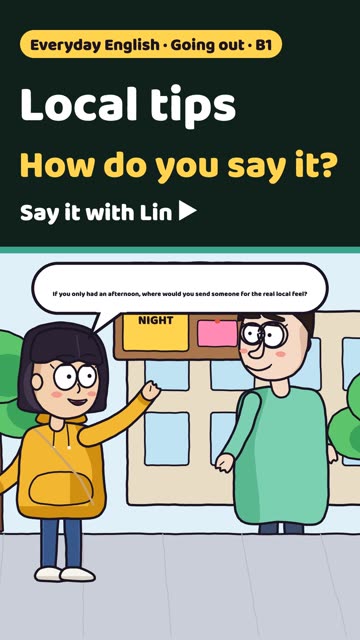
Lin answers: I'm headed to the train station, but my map keeps sending me in circles.
How do you respond to “Yeah, that app does that here. Go straight, then hang a left at the lights”?
Lin answers: After the lights, do I keep going, or is it right there?
How do you respond to “Keep going two blocks; you'll see the station on your right”?
Lin answers: Perfect, thanks—I was starting to think the station was avoiding me.
Key phrases
The lines worth keeping. Read them once before you go out.
Ask for directions
more specific and natural
Make me go in circles
used to complain about maps
Turn left
casual spoken English
Very close
shows it is very near
Common phrases in this scene
Quick answers
What does “point me in the right direction” mean, and when do you say it?
“point me in the right direction”: ask for directions. more specific and natural.
What does “send me in circles” mean, and when do you say it?
“send me in circles”: make me go in circles. used to complain about maps.
What does “hang a left” mean, and when do you say it?
“hang a left”: turn left. casual spoken English.
What does “right there” mean, and when do you say it?
“right there”: very close. shows it is very near.